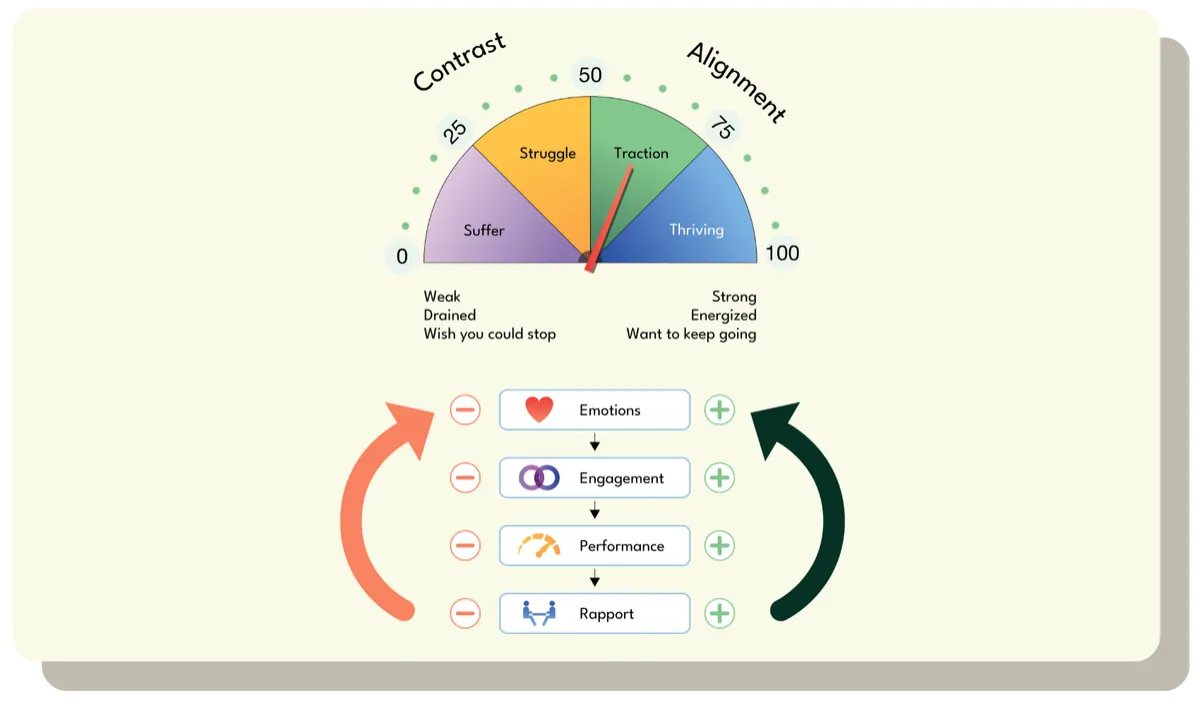
The Alignment Meter: Early Signs a Team Is Coming Apart
When a team is losing alignment, people's feelings and engagement change first. The results change later. Our Alignment Meter gives leaders a way to see those early changes. The meter runs from 0 to 100, with contrast on one side and alignment on the other. When a leader checks where the team is on the Alignment Meter, they can catch contrast while it is still small and act before performance drops.
What the Meter Measures
We define alignment as the state in which all the related parts of a team's effort are working as well as they can, and the outcomes are moving toward thriving. Contrast is the opposite state, where one or more of those parts is not working well and the outcomes are moving away from thriving.
The meter divides that range into four zones. From 0 to 25 is Suffer, and from 25 to 50 is Struggle. Both zones are on the contrast side of the meter. From 50 to 75 is Traction, and from 75 to 100 is Thriving, which are on the alignment side.
Each side comes with a feeling people recognize. Near the low end, there's a feeling of being weak and drained, and people wish they could stop. Near the high end, there's a feeling of being strong and energized, and people want to keep going. Teams usually fall somewhere in between, and the meter gives them shared words for where they are.
Why Feelings Change First
The Alignment Meter connects to a chain of effects. A person can be at different places on the meter in different situations, such as a project that is going well and a meeting that is not. Where someone is on the meter in a given situation determines their emotional state in that situation, which can range from negative to positive. That emotional state affects how much they engage and in what way. Engagement has a strong effect on performance, and performance then affects rapport between individuals and across the team.
The chain of effects also runs back the other way. When rapport weakens, people's emotions turn more negative, and they move further down the meter. When rapport is strong, it improves emotions and engagement, and the team moves up the meter.
The order of the chain of effects explains why results are a late warning. By the time performance falls, the team has already been through changes in emotion and engagement, often for weeks. A leader who watches only the numbers finds out last.
Early Signs of Contrast
Engagement is visible in discretionary effort, which is the effort people give beyond what the job requires, and it is often the first thing to go. Fewer people volunteer to take on a new task. People do only what was asked and stop there. The extra phone call to check on a patient, or the second look at a report before it goes out, gets skipped more often.
People give discretionary effort when three needs are met. Autonomy is having a say in how they do their jobs. Competence is feeling able to do those jobs well. Relatedness is feeling connected to the people they work with. When contrast enters a team, one of these needs usually suffers first, and noticing which one gives the leader a head start on the cause.
In meetings, a team in Traction asks questions and argues about the Methods because they care how things turn out. A team moving down toward Struggle speaks up less. People agree in the meeting and raise their concerns afterward, in smaller conversations with the people they trust.
The way people describe their week is another sign. A team member who calls the week draining, or says they are counting the days to a break, is telling the leader where they are on the Alignment Meter. One comment like that may mean nothing more than a bad week. When a handful of people say similar things over a few weeks, the comments tell the leader where the team is.
Tasks may also slip, with due dates moving by a few days and then by a week, while the people responsible have reasons that each sound fair on their own. One late task is normal, but a run of them across different people usually means contrast is present somewhere in the system.
Contrast Is the Teacher
In our terminology, alignment is the goal, and contrast is the teacher. Contrast is uncomfortable, and it is also useful, because it shows the leader which element is not working well. Without contrast, a team has no information about what to fix and no reason to grow.
A shared Purpose, Outcomes, and Methods (POM) gives a leader a place to look. Sometimes people have lost sight of the Purpose, the why behind what the team does. Sometimes the Outcomes have become unclear, or people disagree about what meaningful progress looks like. Often the trouble is in the Methods, where a factor necessary has no tactic moving it, or an operation has no clear owner.
A team can be clear on its Purpose and still score in the Struggle zone because two of its factors necessary have no tactics behind them. People in that situation feel busy and stuck at the same time. They are working hard on operations that do not connect to the Outcomes, and they can tell. Finding the factors that nobody is moving gives the leader a specific problem to fix, which is far more useful than a general sense that morale is low.
The leader can bring the meter into a team conversation with a few direct questions. Which zone is the team in right now, and which zone does it need to be in to reach its vision of thriving? What is out of alignment, and why is it important to address it? What outcomes would show meaningful progress?
Our standard is progression. No team stays at 100, and a leader who expects perfection will treat every dip as a failure. Moving a team from Struggle into Traction is progress, and the team can feel it in how the week goes long before it appears in a quarterly report.
The next time a leader meets with the team, they can ask each person where they would put the team on the Alignment Meter, and then ask what would move it up five points.