The COIN Model in Practice: Giving Feedback That Actually Lands
Feedback works when it helps someone see their pattern clearly enough to adjust it in the moment. Most feedback does not reach that level of clarity. It points at a problem but leaves the person guessing about what actually happened and what to do differently next time. The COIN model helps because it gives leaders a way to make feedback specific enough to use.
Most people are not struggling because they lack ability or effort. They are working from patterns they do not fully see while they are in them. Those patterns are driven by their talents, which show up quickly under pressure. A leader may notice someone pushing too fast, holding back when tension is needed, or missing signals from the team, but that pattern often feels normal to the person doing it.
COIN stands for Connect, Observe, Interrupt, and Nuance. It is a way to help people work with their patterns so their talents support stronger performance over time. You can find a deeper explanation of the model here: https://positiveleadership.com/post/the-coin-model-turning-raw-talent-into-strength. In feedback, it gives the leader a structure that keeps the conversation clear and grounded.
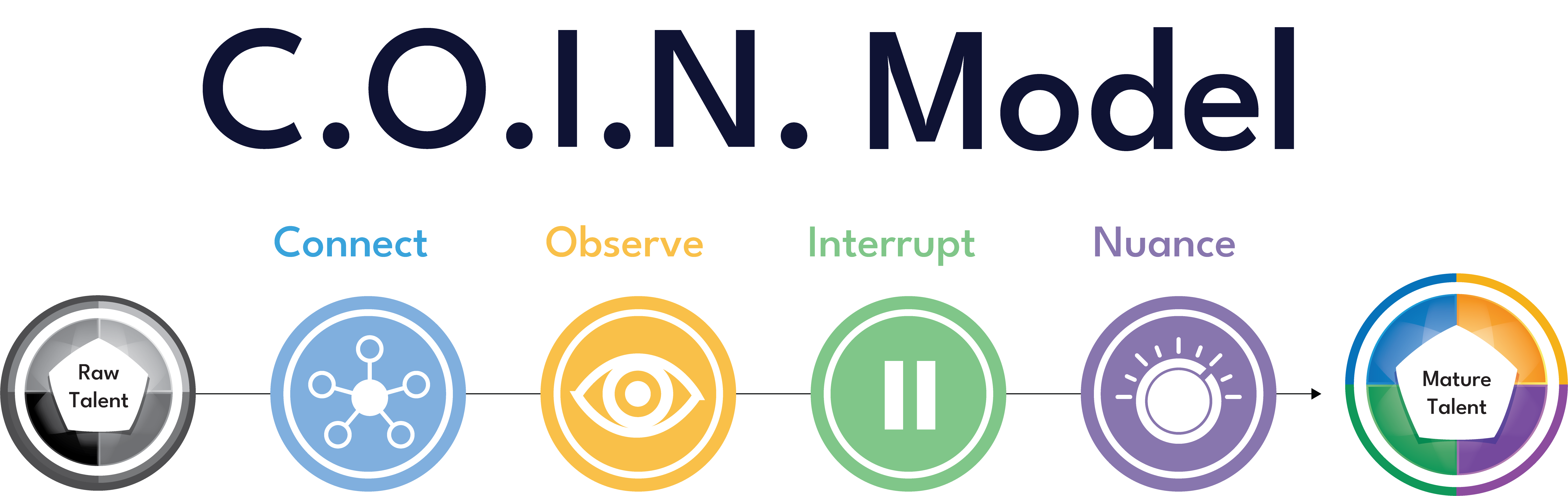
Connect: Anchoring the Conversation
Connect comes first because people need to understand why the feedback matters before they can use it. The leader ties the moment to the work, the outcome, or the impact on others. This helps the conversation stay anchored instead of drifting into something personal. When the connection is clear, people are more likely to stay engaged and listen.
Leaders often move past this too quickly. They jump straight into what went wrong and assume the importance is obvious. When that happens, the feedback can feel like a reaction instead of a useful correction. Taking a moment to connect the issue to the work makes the rest of the conversation easier to follow.
Observe: Describing What Actually Happened
Observe is where the feedback becomes usable. The leader describes what actually happened without adding a label or a conclusion. This requires attention to what was said, what was done, and how the moment unfolded. When the observation is clear, the person can recognize the moment without having to interpret it.
This is where many conversations lose clarity. Leaders rely on words that sound specific but are actually vague. Describing someone as disengaged or careless does not show them what to change. Pointing to the exact behavior gives them something they can see and adjust.
Observe also helps the leader stay accurate. It is easy to assume intent when something goes wrong. That assumption can shift the conversation away from the work and into something harder to resolve. Staying close to what actually happened keeps the discussion grounded and easier to work with.
Interrupt: Creating Space to Change the Pattern
Interrupt is where change becomes possible. The leader helps the person see where they need to pause the pattern and choose a different response. Without that pause, the same pattern will keep showing up in similar situations. Awareness on its own is not enough if the pattern continues to run the same way.
Talents tend to run quickly, especially when the situation feels familiar or pressured. Someone who moves fast may skip input that would improve the outcome. Someone who values agreement may hold back when a harder conversation is needed. Interrupting the pattern creates space to respond with more intention.
Nuance: Refining the Response Over Time
Nuance is where the adjustment becomes more refined over time. The goal is to help the person use their talents with more precision in different situations. This is how performance becomes more consistent. The person is not trying to change who they are, but they are learning how to apply their patterns more effectively.
Nuance also prevents feedback from becoming rigid. People are not given a fixed rule to follow in every situation. They are learning how to read what is happening and adjust their response. That flexibility is what allows talent to support stronger results instead of creating friction.
Timing and Delivery
When leaders use COIN in feedback, the conversation stays focused on behavior and impact in the work. It avoids drifting into assumptions about personality. This makes it easier for the other person to stay engaged and respond without becoming defensive.
Timing still plays a role. Feedback is easier to use when the moment is still clear in both people's minds. Waiting too long makes the conversation harder because details fade and memory shifts. Early feedback keeps the connection to the actual situation.
That does not mean every issue should be addressed immediately. Leaders still need to decide when the conversation will be most useful. A short pause can help the leader observe more clearly before speaking. The key is that any delay supports better clarity rather than avoiding the conversation.
What Changes on the Team
Leaders who use COIN consistently begin to notice patterns more quickly. They pay closer attention to how behavior shows up in real situations. Their feedback becomes more precise because they are working from what they actually see. Over time, this makes feedback feel more normal and less disruptive.
That shift affects the whole team. People spend less time guessing where they stand. They understand what happened and what needs to change. Alignment improves because expectations are clearer in real moments, not just in general terms.
The result is that feedback becomes part of how the team works every day. People learn to adjust their behavior as situations unfold. The work becomes more consistent because fewer things are left unclear or unspoken.