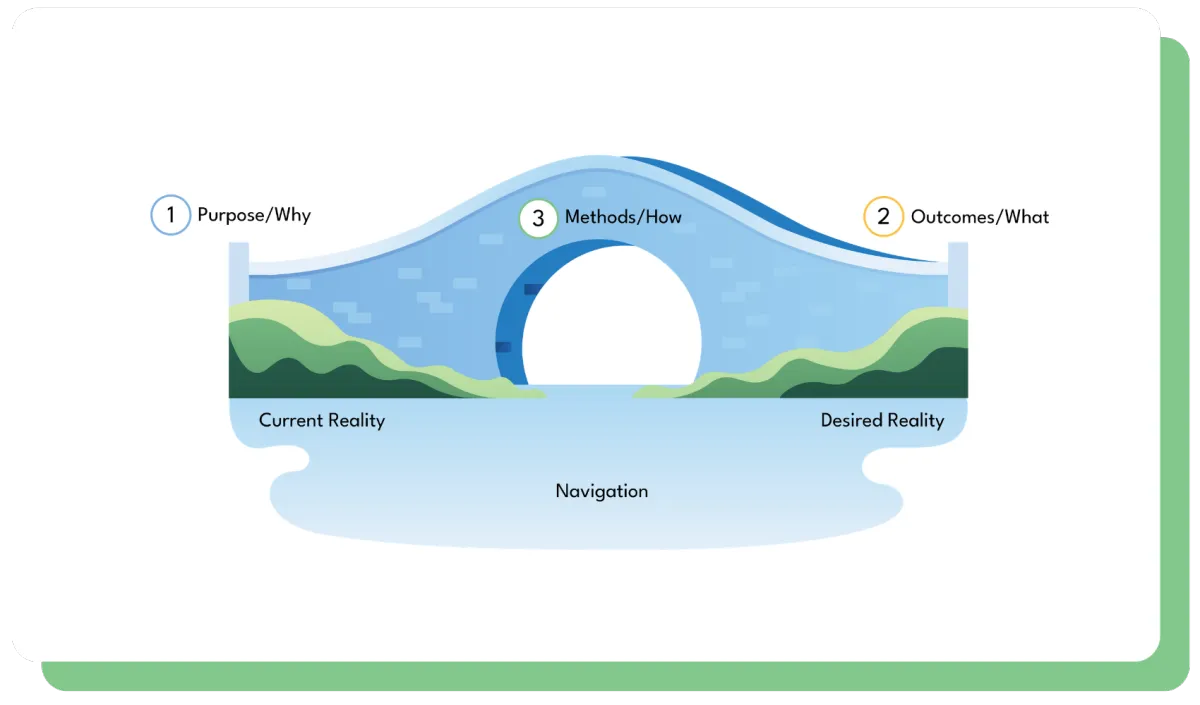
POM: Why Purpose and Outcomes Come Before Methods
Most teams answer the wrong question first. Someone raises a problem, and within minutes the room fills with methods and tactics for fixing it, before anyone has agreed on what the team is actually trying to achieve or why it is worth doing. Positive Leadership uses a plain sequence to correct this, called POM: Purpose, Outcomes, Methods, in that order, and the order is what makes it work. When a team settles purpose and outcomes first, the methods usually fall into place, and the effort connects to results. Skip ahead to methods, though, and people end up working hard on plans that were never anchored to anything, so all that effort scatters.
The appeal of jumping to methods is obvious, because methods feel like action. Debating tactics gives a room a sense of progress, and everyone leaves believing something was accomplished. The trouble surfaces a few weeks later, when the plan is half-built and no one can agree on whether it is working, because the team never defined what "working" would look like.
The Meeting That Starts in the Wrong Place
Almost any planning meeting shows the same pattern. A goal gets mentioned once, quickly, and then the conversation races into execution, into which tool to use and who owns which task. These are method questions, and they pull people in because they are concrete. People would rather argue about a launch date than face the harder question of what the launch is really for.
The cost of starting there is that method debates have no way to resolve. Two smart people can argue forever about the best tactic when they secretly disagree about the goal. The argument looks like a dispute over methods, when it is really a dispute about a purpose no one has named. Teams burn enormous energy in these loops, reopening the same decision again and again, because the foundation the decision should rest on was never poured.
Purpose: What We Are Focused On, and Why
Purpose asks two questions. What is our focus? Why does it matter? A team needs both answers. When the focus is clear but no one has said why it matters, people comply, doing the task because they were told to and little more. The opposite miss is just as common: a strong reason with no clear focus, which leaves people motivated and unsure where to point that motivation.
Purpose is also the test that every method has to pass later. When a team knows precisely what it is trying to achieve and why, a weak tactic reveals itself quickly, because anyone can see it does not serve the purpose. Without that anchor, every idea looks equally reasonable, and the team defaults to whatever the most senior or most confident person prefers. With a clear purpose, the team has a standard to hold each idea against, and that standard is what settles which idea wins, in place of rank or the loudest voice. It gives the newest person in the room a fair basis to say that a popular plan will not get the team where it said it wanted to go.
Outcomes: What Thriving Looks Like Here
Outcomes is the question teams skip most, and the one that does the most work when it is answered well. An outcome describes what thriving looks like for this particular focus. It is a plain description of the result, stated clearly enough that the team could look back later and agree on whether they reached it.
Most teams confuse outcomes with activity. They list the actions they will take, when the real question is what those actions are supposed to produce. Shipping a feature is an activity, and it is easy to mistake for an outcome. The outcome is customers renewing because that feature solved a real problem. The distinction sounds minor, but it changes how a team behaves. A team focused on an activity declares victory the moment the activity is finished, whether or not it produced anything. Aim at an outcome instead, and stopping is not an option until the result actually arrives.
A marketing team I worked with spent an hour debating channels and budgets before someone asked what the campaign was supposed to achieve. The honest answer turned out to be that no one knew, beyond a vague wish for more awareness. Once they named the outcome, qualified leads the sales team could actually close, half the earlier debate evaporated, because most of the tactics they had been fighting over had nothing to do with that result. The hour of arguing had been a symptom of a missing outcome. The team was not really disagreeing about tactics at all.
Naming the outcome first is also what makes it safe to change methods without fear. When everyone agrees on the destination, swapping one route for a better one feels like progress. Take away that shared destination, and changing methods starts to feel like failure or indecision, so teams cling to plans that clearly are not working. The outcome gives them permission to drop a method that is not serving it.
Why Methods Come Last for a Reason
Methods are the strategies, tactics, and daily operations that move a team toward the outcome. They count, and they come last on purpose. Methods are the easiest of the three to generate, because most experienced people have a long list of things they know how to do. They are also the least useful in isolation, because a method disconnected from purpose and outcome is a solution hunting for a problem to justify it.
Once purpose and outcomes are settled, methods become a genuinely open question, and that openness is a strength. The team can try one approach and measure its outcome, then switch to another if the first falls short, since the switch does not threaten anything the team cares about. POM connects to Progression Theory here. Thriving comes when purpose, outcomes, and methods point in the same direction, and the methods keep improving while the purpose and outcome stay steady. A team with all three aligned can move fast and adapt often. When the first two are missing, that same speed becomes motion mistaken for progress, and no one notices until the results fail to appear.
There is a reason the order runs P, then O, then M, and not the reverse. Purpose is the why behind the movement. Outcomes name where the team is going, and methods are the how of getting there. Deciding how before you know where is what leaves organizations busy and exhausted while heading in the wrong direction, having executed a plan flawlessly toward a place they never meant to reach.
The sequence also works as a diagnosis. When a project stalls and no one can say why, walking it back through POM usually finds the break. Much of the time, the methods are fine and the outcome was never defined, so the team has been executing with energy toward a target no one ever drew. Naming that target is often the whole fix.
None of this requires a longer meeting. It requires spending the first ten minutes on the two questions teams usually rush past. A leader can hold the room on purpose and outcome until both are clear enough to write in a single sentence, and only then open the question of methods. That conversation will be shorter and calmer, and it will land on something the team actually wanted. Ten minutes spent at the front save the months a misaimed plan would otherwise waste, and the people doing the work finally know what they are aiming at.